

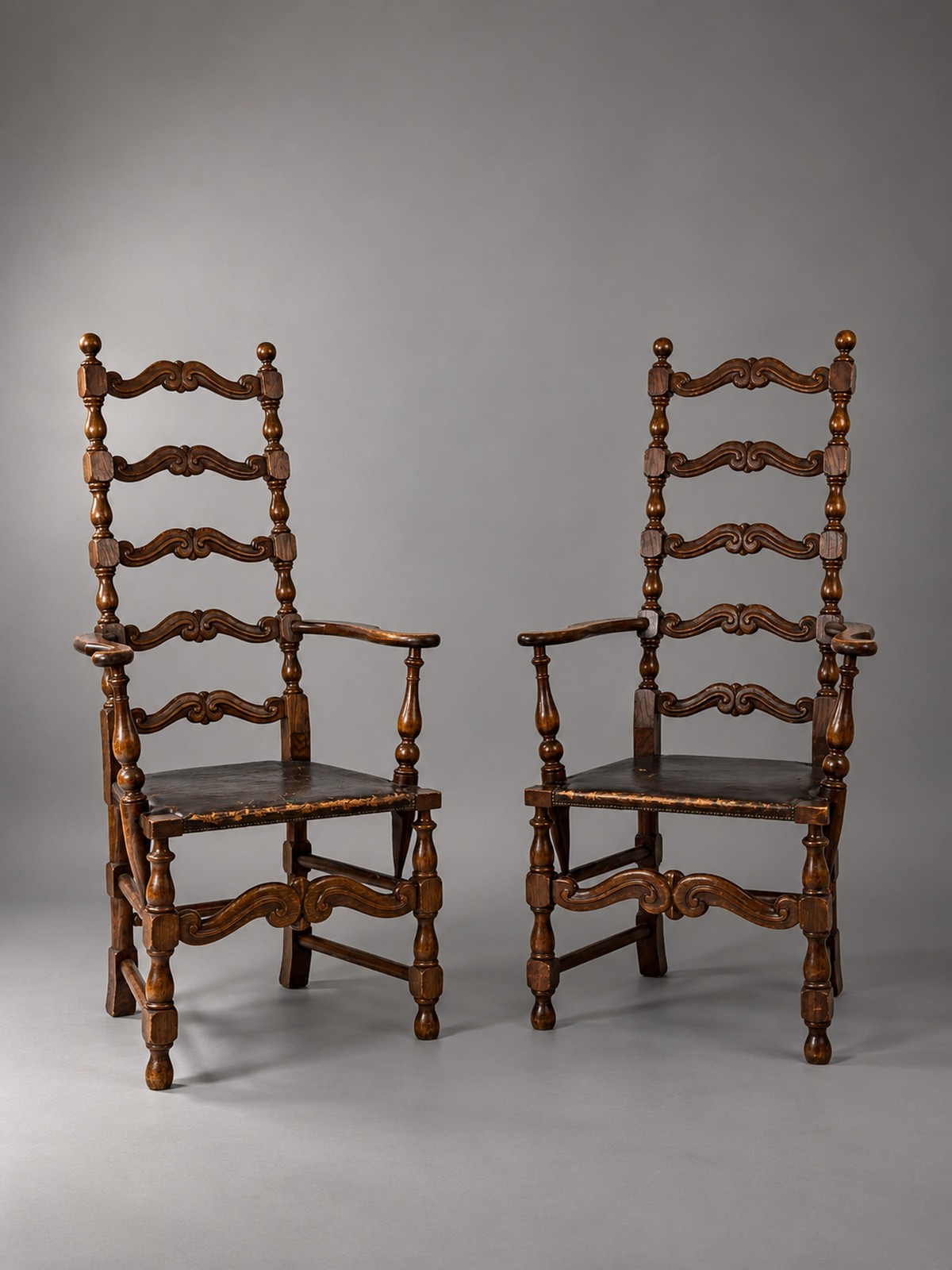
Nordiska Kompanier (NK), armchairs
Price on request
Stockholm, 1913. At the beginning of the 20th century, Nordiska Kompaniet stood at the centre of a rapidly changing Swedish design culture. Founded in 1902, NK’s furniture department brought together skilled craftsmen, architects and designers at a moment when Sweden was beginning to develop the design identity that would eventually become internationally celebrated. These two chairs were created within this environment. Crafted in wood and upholstered in leather, the chairs combine a strong architectural silhouette with a restrained elegance. The tall backs, gently curved arms and carefully considered proportions give them a distinctly modern presence despite their age. More than a century later, an important part of their history remains physically attached to them. Each chair carries Nordiska Kompaniet’s original metal identification plaque, including the number 7852-23. Research in the surviving NK records has allowed this number to be traced to 1913, providing an unusually precise documented date for the chairs. This places their creation during one of the most fascinating periods in the history of Nordiska Kompaniet. At the time, David Blomberg was a leading figure in NK’s furniture design department and served as its chief designer during this formative period. Blomberg was associated with Nordiska Kompaniet from 1902 until 1917 and played an important role in shaping the company’s early furniture production. The chairs therefore belong directly to the period in which Blomberg was helping establish the aesthetic direction of NK furniture. Without documentary evidence connecting this particular model directly to Blomberg, the chairs should not be presented as a confirmed Blomberg design. Their documented 1913 date, however, places them firmly within his era at Nordiska Kompaniet and within the design culture he helped shape. This was also a transitional moment in Swedish decorative arts. The heavier historical references of the late 19th century were gradually giving way to cleaner lines, stronger proportions and a new interest in craftsmanship, materials and architectural simplicity. Within only a few years, these ideas would contribute to the development of Swedish Grace and, ultimately, Scandinavian modernism. Seen in that context, the chairs become more than simply pieces of early 20th-century furniture. They are surviving objects from the formative years of one of Sweden’s most important design institutions. Their wood construction, leather upholstery and beautifully balanced profiles retain the character of furniture made before Swedish design became an international phenomenon. And beneath each chair, the small NK plaque provides something increasingly rare: a direct link back to Stockholm in 1913. Nordiska Kompaniet, Stockholm, Sweden, 1913. Wood and leather. Marked with original Nordiska Kompaniet metal plaques and number 7852-23. Dated through the Nordiska Kompaniet records.
- Date of Manufacture
- 1913
- Creators
- Creators By NK (Nordiska Kompaniet) Manufacturer
- Materials
- Leather Oak
- Measurement Units
- Centimeters (cm)
- Measurement Type
- Rectangular
- Measurements
- Height * 122 cm Width * 52 cm Depth * 43 cm Seat Height 50 cm Weight *
- Item Condition
- Good