
Edward Hald Table Lamp in Frosted Glass, Seagrass Shade and Brass for Orrefors
Price on request
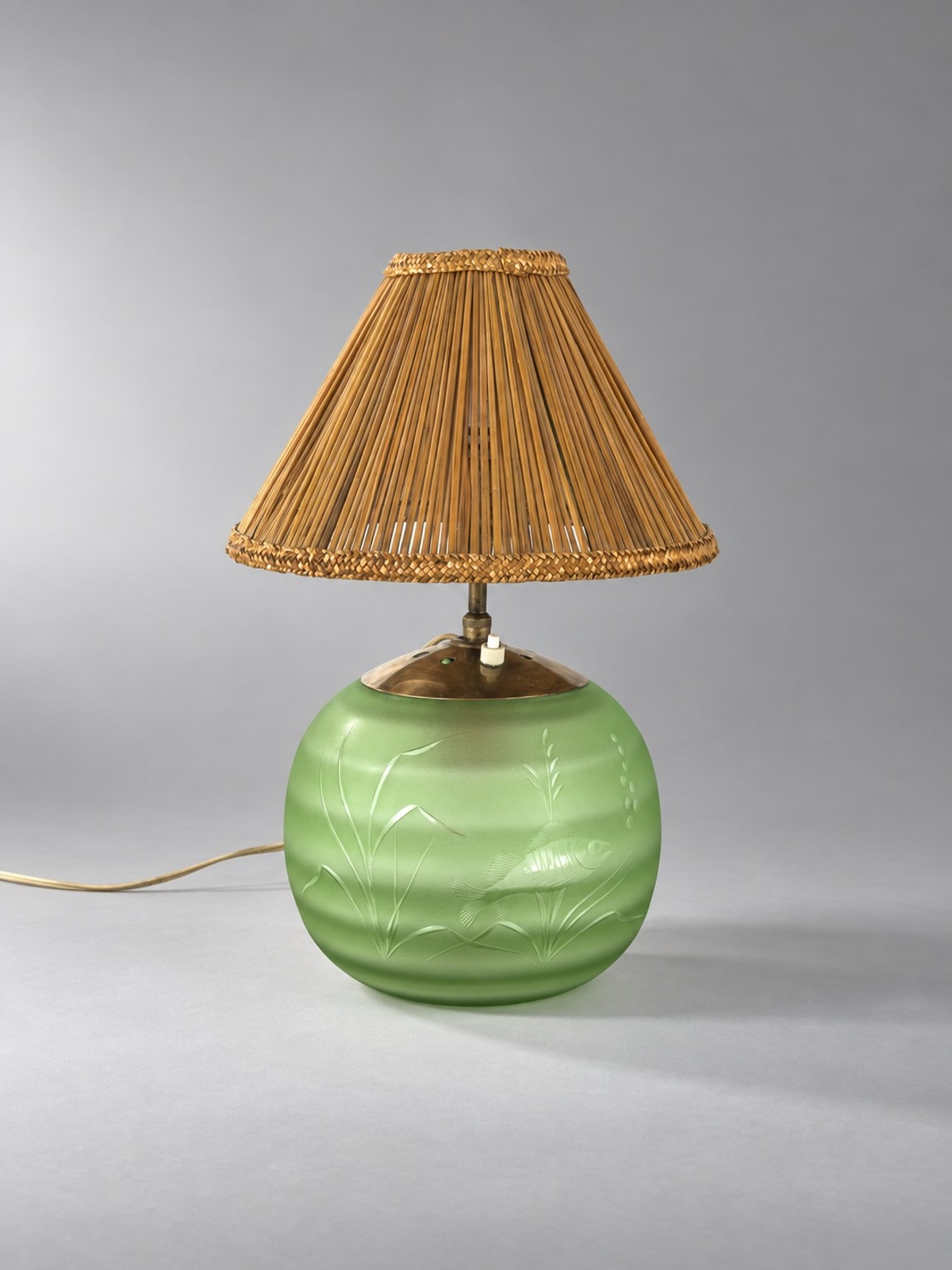
Paris, 1909. A young Swedish artist is studying under Henri Matisse. Eight years later, he arrives at a glassworks deep in the forests of Småland. His name was Edward Hald, and the journey between those two places would become part of one of the most remarkable chapters in Swedish design history. Before glass entered his life, Hald had already moved through several worlds. Born in Stockholm in 1883, he studied in Leipzig, explored architecture and eventually turned toward art. In Paris, he became a pupil of Henri Matisse, encountering the radical new ideas about colour, line and expression that were transforming European art. Then, in 1917, Hald arrived at Orrefors. The contrast could hardly have been greater. From the studios and boulevards of Paris to a glassworks surrounded by the dark forests of Småland. Here, the atmosphere was shaped by fire and craftsmanship: the intense heat of the furnaces, molten glass turning at the end of a blowpipe and generations of knowledge carried in the hands of the glassworkers. It was here that Hald found the material that would define his career. Together with Simon Gate and the highly skilled craftsmen at Orrefors, Hald became one of the central figures in the transformation of Swedish glass from industrial production into an internationally recognised artistic medium. Glass offered possibilities that painting never could. It could capture light. It could diffuse it, reflect it and allow it to travel through the material itself. A surface could be clear or frosted, smooth or engraved. Colour could appear solid in one moment and almost disappear when illuminated. Hald understood those qualities exceptionally well. His work frequently carried a narrative and poetic character. Fish, figures, landscapes and scenes from everyday life appeared across his glass, turning functional objects into small worlds of their own. Then came Paris, 1925. Orrefors presented its work at the Exposition Internationale des Arts Décoratifs et Industriels Modernes, the exhibition that would later lend its name to Art Deco. The Swedish glass caused an international sensation. Its clarity, restraint and delicate decoration offered something distinctly different, and Hald was awarded a Grand Prix. Orrefors had achieved its international breakthrough. The young artist who had once travelled to Paris to learn was now returning with a new Swedish language of glass. This table lamp was created by Edward Hald for Orrefors and belongs to that remarkable tradition. Here, Hald’s understanding of glass becomes inseparable from his understanding of light. The body is formed in frosted glass, its cool, softly textured surface preventing the light from simply passing through. Instead, it catches and diffuses it, giving the glass a quiet luminosity. Above it sits the muted sea-green shade. The colour introduces an entirely different sensation. Against the pale frosted glass and the warmer metal below, the green feels calm and atmospheric — reminiscent of still water or the subdued colours of the Scandinavian landscape. And then there is the brass. Its warm golden surface provides a deliberate counterpoint to the cooler materials surrounding it: cold glass against warm metal, translucency against solidity, pale frost against deep sea green. When the lamp is unlit, these materials can be read individually. Switch it on, and they begin to interact. Light softens behind the shade. The frosted glass takes on a gentle glow. Small reflections appear across the brass, warming its surface as the surrounding room becomes quieter and more intimate. It is precisely this relationship between material, colour and light that makes the lamp so compelling. By 1930, Hald would take his fascination with glass and light to an extraordinary scale with Himmelsgloben — the Celestial Globe, created for the Stockholm Exhibition. Its engraved constellations transformed clear crystal into an image of the heavens, with light allowing stars and figures to appear almost suspended within the glass. It was the culmination of an idea that runs through so much of Hald’s work: glass was never simply a material. It was a way of working with light. More than a century after Hald first arrived at Orrefors, this lamp still carries something of that world within it. The forests outside the glassworks. The heat of the furnace. The coolness of finished glass. The warmth of brass beneath the hand. And the transformation that occurs when darkness falls and the lamp is illuminated. From Matisse’s Paris to the furnaces of Orrefors — and from Småland back out into the world. This lamp belongs to that extraordinary journey.
- Date of Manufacture
- 1940
- Creators
- Creators Attributed to Edward Hald Designer Attributed to Orrefors Manufacturer
- Materials
- Brass Glass Seagrass
- Measurement Units
- Centimeters (cm)
- Measurement Type
- Circular
- Measurements
- Diameter * 20 cm Height * 32 cm
- Item Condition
- Good